
Call Us For A Free Quote
Asphalt Seal King Blog: Expert Sealcoating Resources for Bradford, Newmarket & Aurora
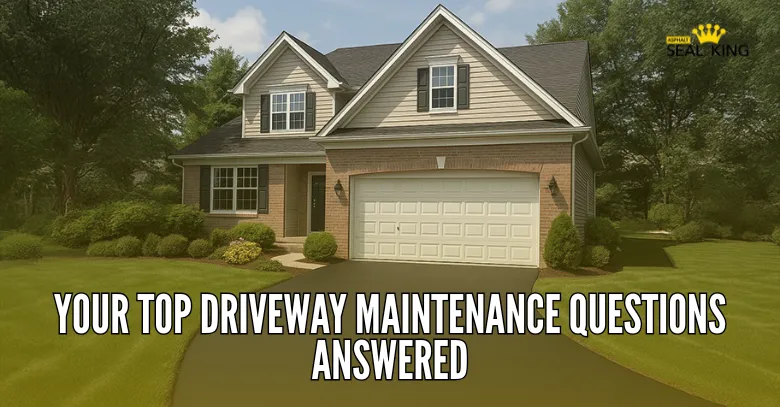
Ask the Experts: Your Top Driveway Maintenance Questions Answered
"How often should I seal my driveway?"
"Is it too late to fix these cracks?"
"What's the real difference between your service and the stuff I can buy at the hardware store?"
As Bradford and Aurora's trusted asphalt experts, we've heard every question imaginable about driveway maintenance. And we love it. Why? Because an informed homeowner is a protected homeowner. Your driveway is a massive investment—a key part of your home's value and curb appeal—and in our Southern Ontario climate, it's an investment that is constantly under assault.
Between the brutal freeze-thaw cycles of winter, the baking UV rays of summer, and the chemical attacks from de-icing salt, your asphalt is in a 365-day-a-year battle. All this confusion leads to one of two things:
Paralysis: You're not sure what to do, so you do nothing, which is the most expensive mistake of all.
Bad Decisions: You hire the cheapest "blow-and-go" company or try a DIY product that ends up causing more harm than good.
We want to clear the air. To position you, the homeowner, as the expert of your own property. That's why we've compiled this comprehensive guide, answering the most common and critical questions we receive from your neighbours in Bradford, Aurora, and beyond.
This is your definitive driveway FAQ. Let's get started.
1. How often should I really seal my asphalt driveway?
This is, without a doubt, the most common question we get. You'll hear all sorts of answers, from "every year" to "never." The truth, based on decades of pavement science, is comfortably in the middle.
The Short Answer: Every 2 to 3 years.
The Detailed Answer:
A professional-grade sealcoat is a sacrificial, protective layer. It's designed to take the beating from sun, salt, and water so that your structural asphalt doesn't have to. Here's the breakdown of the timing:
Why Not Every Year? Sealing too often (especially with cheap, acrylic-based products) can be harmful. It can lead to a thick, brittle layer that "shales" or flakes off. More importantly, your asphalt needs to remain flexible. Over-sealing can trap moisture and solvents, preventing the pavement from "breathing" and leading to premature failure.
Why Not Every 5+ Years? In our Bradford and Aurora climate, this is a dangerous gamble. By the 3-year mark, a sealcoat has typically worn away in high-traffic areas, and its UV-blocking and waterproofing properties are significantly diminished. Waiting 5 years means you've likely had 2-3 full seasons of your driveway being exposed and unprotected. That's two full winters of the freeze-thaw cycle attacking your pavement, which is how tiny cracks become potholes.
The "Bradford Factor": Our 2-3 year recommendation is firm because of our local weather. The intense freeze-thaw cycles and heavy use of de-icing salts mean our driveways are under far more stress than one in a milder climate.
Your Driveway Will Tell You: Don't just look at the calendar; look at your driveway. It's time to call us when you notice:
Fading: The rich, black colour has faded to a dull grey, which means the binder is oxidizing and the surface is "thirsty."
Water Soaks In: After it rains, does the water soak in and stay dark for hours? It should bead up and run off. If it's soaking in, it means the surface is porous and water is penetrating to the foundation.
Hairline Cracks: You're seeing the first 5 signs your driveway needs attention (like small, hairline cracks). This is the perfect time to perform preventative maintenance.
2. What's the difference between your professional sealing and the stuff I can buy at the hardware store?
This is our favourite question because the difference is so staggering, it's like comparing a professional firefighter's turnout gear to a plastic rain poncho. They both look like "coats," but they are not in the same category.
The Short Answer: The difference is in the product and the process. Ours is a professional-grade, asphalt-based product designed for protection. Theirs is often a water-based, acrylic "paint" designed for a temporary "black" look.
The Detailed Answer:
PART A: THE PRODUCT
DIY "Big Box" Sealers: These are almost exclusively water-based, acrylic-emulsion sealers. To keep the cost down, they are very low in "solids" (the actual protective asphalt and polymer content) and high in water and "fillers" (like ash or clay).
The Problem: They are essentially a very thin, brittle paint. They look black, but they provide almost no waterproofing or UV protection. Worse, because they are a non-porous, "plastic-like" coating, they can trap moisture, accelerating peeling, flaking, and "shaling" (where the top layer of asphalt delaminates). They also have no traction, making your driveway dangerously slippery when wet.
Asphalt Seal King Professional Sealant: We use a commercial-grade, asphalt-emulsion-based sealant. This is a product that cannot be bought at a retail store.
High-Solids: It's packed with the "good stuff"—asphalt, petroleum binders, and polymers.
Polymer Fortified: We add specialized polymers for enhanced flexibility. This is critical in our climate. When the temperature drops to -20°C, our sealant remains flexible and moves with your asphalt instead of cracking and splitting open.
Silica Sand: We mix in a specific aggregate of high-grade silica sand. This serves two vital purposes: 1) It creates a high-traction, non-slip surface that is safe. 2) It creates a durable, "wear layer," like the aggregate in your asphalt itself, dramatically increasing longevity.
PART B: THE PROCESS
DIY Process: You buy a bucket, a squeegee, and a brush. You might sweep off the leaves. You apply it. You might accidentally seal over oil spots (which will peel right off) or fill cracks with a cheap, rigid "filler" that will pop out by the first frost.
Asphalt Seal King Process: Sealing is only 10% of the job. The other 90% is meticulous preparation. As we outline in our What to Expect guide, our process includes:
Deep Cleaning: Using power brooms and high-velocity blowers to clean not just the surface, but inside the pores and cracks.
Professional Edging: We use steel-blade edgers to clear all encroaching grass and weeds, ensuring we seal the entire pavement edge-to-edge.
Oil Spot Priming: We treat all oil and gas stains with a specialized chemical primer. You cannot seal over an oil spot; the sealant will not bond. Our primer bonds to the oil-soaked asphalt and creates a new surface for the sealant to bond to.
Professional Crack Repair: We don't use "filler." We use hot-pour or commercial-grade rubberized sealant, which is the only thing that will survive a Canadian winter (more on that next).
Application: We apply our commercial-grade sealant using brushes, squeegees, and spray methods, depending on your driveway's needs, to ensure a thick, uniform coat that penetrates the asphalt.
The difference is "cosmetic paint" vs. "structural protection."
3. Is it too late to seal my driveway? It already has a lot of cracks.
This is a common and understandable fear. Homeowners see a web of cracks and assume the driveway is a lost cause and they're facing a $20,000 replacement bill.
The Short Answer: It is almost never too late. But it means the job has changed from a simple "seal" to a "repair and seal."
The Detailed Answer:
This is the most important concept in asphalt maintenance: Sealant is a protective layer, not a structural one. You cannot "fix" a crack with sealant. Sealant is a "skin"; cracks need "stitches" or "surgery."
Here's how we approach your cracked driveway:
Step 1: Triage. We perform a full "triage" on your driveway. We identify two different types of cracks, and each gets a different prescription.
Step 2: Treat Linear Cracks (The "Stitches"). For the long, individual cracks—the ones running up, down, or across your driveway—we perform a driveway repair.
We clean them with compressed air and wire wheels to get a clean, raw surface for bonding.
We fill them with our hot-pour (or commercial-grade) rubberized crack sealant. This flexible material bonds to the asphalt and stretches and compresses as your driveway moves with the seasons, keeping water out permanently.
Step 3: Treat Alligator Cracks (The "Surgery"). If you have those web-like "alligator" cracks, this is a different problem. This is a sign of sub-base failure (see the next question). We will tell you truthfully that sealing over this is a waste of money. The only correct fix is to perform "asphalt surgery":
We use an asphalt saw to cut out the entire failed "alligator" section.
We excavate all the broken asphalt and the wet, failed gravel foundation underneath.
We rebuild the foundation with new, compacted aggregate.
We pave a new patch with hot, new asphalt.
Step 4: The Seal (The "Protection"). After the stitches are in and the surgery is complete, then we apply the sealcoat. This protective layer unites the entire surface, protects the new patch, and waterproofs the crack-filler, giving your entire driveway a new, uniform lease on life.
So, no, it is not too late. It just means you need a professional who can handle the repairs properly, not just paint over them.
4. Why can't you just fill my "alligator" cracks? My last guy did.
The Short Answer: Because it's a scam. It's like putting a Band-Aid on a broken leg. We refuse to take your money for a "fix" that we know will fail in 3-6 months.
The Detailed Answer:
We get this question from homeowners who have been burned before. A "blow-and-go" company showed up, sprayed black sealer over their alligator cracks, and it looked "fixed." A few months later (usually after one winter), the cracks were back and looked even worse.
You must understand what alligator cracks are. They are not a surface problem; they are a foundation problem.
The Cause: Water (from unsealed pavement) penetrated your asphalt and saturated the gravel sub-base underneath your driveway.
The "Freeze-Thaw" Hammer: In the winter, that trapped water in your sub-base froze. Water expands by 9% when it freezes, and this expansion heaves your driveway up.
The "Thaw-Collapse": In the spring, that ice melts, leaving a hollow, water-filled "sponge" where a solid foundation used to be.
The "Shatter": The next time you drive your 4,000-lb vehicle over that unsupported, "hollow" asphalt, the pavement has no foundation. It flexes and shatters into the "alligator" pattern.
Now, knowing this, what do you think "filling" those cracks with sealer will do? Absolutely nothing. The foundation is still a wet, failed sponge. The "filler" will just sit on top, and the cracks will reappear as soon as the ground moves.
The only honest, structural driveway repair is the "surgery" we described in the last question: Cut out, dig out the failed base, rebuild the base, and re-pave.
Any contractor who tells you they can "fix" alligator cracks by just "filling" or "sealing" them is not a professional; they are a con artist.

5. What time of year is best to seal a driveway in the Bradford / Aurora area?
The Short Answer: The "sealing season" in our area is typically from late May to early October.
The Detailed Answer:
Professional asphalt sealing is a very weather-dependent process. To cure properly, our commercial-grade sealant needs a specific set of conditions.
Warm Temperatures: We need both the air and the ground temperature to be at least 10°C (50°F) and rising.
The "Ground Temp" Problem: This is what stops us from sealing in April or early May. Even on a sunny, 15°C day, the ground itself is still frozen or ice-cold from the night. Applying a water-based emulsion to a cold surface is like spraying water on a cold window—it just sits there. It won't bond, and it will cure improperly.
No Rain: We need a clear 24-48 hour window after the application for the sealant to cure. If it rains on fresh sealant, it can wash it away or, worse, re-emulsify it (turn it back into a brown, soupy mess).
Sunlight (The "Cure Accelerator"): The sealant "cures" as the water in the emulsion evaporates, allowing the asphalt and polymer solids to link together and form a hard, durable shell. Direct sunlight and low humidity speed this up.
Why We Can't Seal in Late Fall (e.g., November):
Even on a "nice" November day, the nights are too cold and long, and the sun angle is too low. A sealant that takes 4 hours to cure in July might take 4 days to cure in November. This long, slow cure is weak and will likely fail by spring.
We only schedule jobs when we are 100% confident the weather will allow for a perfect, durable cure.
6. How long do I have to stay off the driveway after sealing?
The Short Answer:
Walking (and pets): 24 hours.
Driving: 48 hours (minimum) to 72 hours (preferred).
The Detailed Answer:
It's crucial to understand "curing" vs. "drying." Your driveway might be "dry" to the touch in a few hours, but it is not "cured." Curing is the chemical process of the solids bonding, and it takes time.
24 Hours (Walking): Please, do not walk on it for a full 24 hours. This includes kids, pets, and delivery drivers. A footprint or a paw print in the first 24 hours can be permanent.
48-72 Hours (Driving): We will give you a specific timeframe based on the weather. On a hot, sunny, low-humidity July day, 48 hours is often fine. On a cool, cloudy September day, we will insist on 72 hours.
The "Power Steering Scuff" Warning: This is the most common issue. For the first 1-2 weeks, the sealant is still "seasoning" and is a bit "soft," especially on hot days. DO NOT turn your car's wheels while the vehicle is stationary. This will create "power steering scuffs" (half-moon marks). These are not a product failure; they are an operator error. You must be gentle for the first two weeks.
7. Will sealcoating make my driveway slippery?
The Short Answer: No, our professional process will actually increase traction.
The Detailed Answer:
This is a very valid concern. A driveway that is slippery when wet is a massive liability. This "slippery" reputation comes from cheap, acrylic, "big-box" sealers. As we mentioned, those are like a coat of plastic—they are non-porous and have zero texture.
Our process is the opposite. One of the key ingredients in our commercial-grade sealant mix is silica sand. We mix a high-grade, angular sand aggregate directly into the sealant. This does two things:
Traction: It creates a high-traction surface profile, similar to fine-grit sandpaper. This makes your driveway safer when wet or on an incline.
Durability: The sand acts as a "wear layer," just like the aggregate in your asphalt. Car tires will wear on the sand particles, not on the sealant binder itself.
So, no. A cheap DIY job will be slippery. Our professional application is engineered for safety and traction.
8. How much does it cost to seal an asphalt driveway?
The Short Answer: It depends entirely on the size and condition of your driveway. But it's far and away the cheapest form of "property value insurance" you can buy.
The Detailed Answer:
We can't give a flat price here, and you should be very wary of any company that does. A "one-size-fits-all" price means they aren't accounting for what your specific driveway needs. The final price is an investment based on three main factors:
Size (Square Footage): This is the biggest factor, as it determines the amount of material and time required.
Preparation: Is your driveway relatively clean, or is it covered in moss and caked-on dirt? Does it require extensive power-brooming and edging?
Repairs (The Real Variable): This is what separates a $500 job from a $1,500 job.
A newer driveway that just needs a "seal" will be on the lowest end of the price spectrum.
A 10-year-old driveway that needs 200 linear feet of hot-rubber crack filling, 3 pothole patches, and extensive oil-spot priming will cost more. But that driveway repair and sealing job is still 1/10th the cost of replacing the entire driveway, which is what will happen if you don't do the work.
A Warning on "Price vs. Cost":
A "cheap" price (e.g., a $199 flyer-in-the-mailbox special) has a very high cost. That price is only possible by using watered-down, low-quality material, skipping all prep work (like priming oil spots), and doing a 30-minute "spray-and-pray" job. This "cheap" job will fail, and worse, it may trap moisture and cause damage.
Our price reflects a meticulous process, premium, commercial-grade materials, and professional, insured labour. It is an investment that will actually protect your driveway for years.
9. Will sealing my driveway "fill in" my cracks?
The Short Answer: No. This is the #1 misunderstanding in the industry. Sealant seals, Filler fills.
The Detailed Answer:
Think of it this way:
Filler is the "stitches." We use our hot-pour rubberized filler to "stitch" a crack together. This makes the crack waterproof and stable.
Sealant is the "skin" or "liquid bandage" that goes over the entire driveway (including the stitches) to protect it.
A coat of sealant is only as thick as a few playing cards. It has zero structural or "filling" properties.
Managing Your Expectations (Honesty First):
After a professional driveway repair and seal, you will still see where the cracks were. You will see the texture of the rubberized filler underneath the black sealant. This is not a sign of a failed job; it is the sign of a correct job. It's like a healed wound: the scar is there, but the wound is closed and protected.
Any company that tells you their "special sealant" will "make your cracks disappear" is lying. They are just painting over them, and those cracks will be open and exposed again in months.
10. Can you seal my new asphalt driveway?
The Short Answer: Not yet! Please wait 6-12 months.
The Detailed Answer:
A brand new asphalt driveway looks beautiful, and you want to protect it. We get it! But sealing it too early is one of the worst things you can do.
New asphalt is "curing." It is full of light oils and solvents (petroleum distillates) that give it its flexibility and allow it to be worked. These oils must evaporate for the asphalt to harden and "cure" properly. This process takes 6-12 months.
What happens if you seal it too early?
You will trap those solvents.
The sealant itself will not bond correctly to the "oily" surface.
You will prevent the asphalt from hardening, leaving it soft and pliable. It will be prone to tire marks, scuffs, and indentation.
When is it ready?
Your new driveway is ready for its first seal when it has faded from a "tacky," deep-black to a lighter grey-black, and water no longer "beads" on the surface. For our climate, we recommend letting it go through its first winter, and then calling us in the late spring or summer.
As the industry-leading National Asphalt Pavement Association (NAPA) confirms, letting a new pavement cure is an essential step before any maintenance plan begins.
Still Have Questions? Ask the Real Experts.
We hope this guide has armed you with the knowledge to make an informed decision. But we also know that every driveway is unique. Your home, your trees, your drainage, and your driveway's history are all unique factors.
The best answers aren't on a webpage; they're from a professional standing on your driveway.
If you're in the Bradford, Aurora, or surrounding area, we invite you to call us for a 100% free, no-obligation consultation and quote. An Asphalt Seal King expert will walk your property with you, answer your specific questions, and provide a clear, transparent plan to protect your investment.
Call Us Today for Your Free, No-Obligation Quote: +1 (289) 803-7626
Or visit our Contact Page to book your consultation online.

Driveway Sealing Service Areas
Snow Plowing Service Areas
Contact Us
Asphalt Seal King
(289)716-5557
Hours: Mon – Sun 8:00am - 9:00pm


